The Man Behind the Silence
At home, he seemed like an ordinary man.
A reserved, disciplined father who rarely spoke about his work. He noticed everything. His family called him “Maigret”.
Behind that quiet presence lay a professional life that his children would only fully understand many years later.
Raffaele De Blasio spent much of his career in Rome, working in a world of investigations, major criminal cases and mysteries that would leave their mark on Italian history.
Much of his work took place away from public attention. According to family recollections, he observed, gathered information, reconstructed events and followed investigative leads. He was not necessarily the public face of the operations to which he contributed.
His children also remember the less visible side of his profession: unexpected telephone calls, absences, silences and the distance between family life and a job that was rarely discussed.
It is from this distance that his story begins.
Not simply the story of a police officer, but of a man who lived through defining decades of Italian history, leaving behind memories, testimonies and questions still waiting to be explored.

The Questura of Rome in the 1950s. Historical photograph © Archivio Storico Istituto Luce.
The Questura of Rome in the 1950s. Historical photograph © Archivio Storico Istituto Luce.

A police official among the records of Rome's Questura, 6 August 1955. Historical photograph, Istituto Luce archive. The image illustrates the working environment of the period and does not depict Raffaele De Blasio.
A police official among the records of Rome's Questura, 6 August 1955. Historical photograph, Istituto Luce archive. The image illustrates the working environment of the period and does not depict Raffaele De Blasio.
The Man
Once, he returned home with his face and clothes covered in dirt. He offered no explanation. Only later would the family learn that, during an investigation, he had blended in with farmers to gather information without being recognised.
For many years, his children knew mainly the father who came home, not the man behind the investigations. His work entered family life through brief signals: a telephone call interrupting the day, a sudden absence, an unexpected return. Raffaele explained very little. Discretion was not merely part of his character; it was part of his profession.
Only much later, piecing together colleagues’ accounts, preserved photographs and fragments of memory, did the family begin to discover the other side of his life. Behind the man who could joke and be friendly stood a rigorous, exceptionally observant investigator and, in his children’s recollections, an incorruptible one. A man who seemed born for the job.

Rome, 30 May 1959. Raffaele De Blasio with his wife and son. Courtesy of the De Blasio family.
Rome, 30 May 1959. Raffaele De Blasio with his wife and son. Courtesy of the De Blasio family.
From Benevento to the Police
Behind that ordinary appearance, however, was a man who seemed almost perfectly suited to the profession he had chosen.
In his children's memories, Raffaele was rigorous, extremely serious when duty demanded it, and deeply loyal to his institutional responsibilities. They describe him as incorruptible, a man for whom serving the State was not simply a phrase, but a way of life.
Outside work, he could be cheerful, approachable and at ease with others. Yet that natural manner never diminished his investigative instinct: he observed, listened and registered details. He seemed to do so effortlessly, as though the profession was not merely a job he had chosen, but one that suited his very nature.
Raffaele De Blasio was born in Benevento on 24 October 1925, into a farming family. He attended school until the fifth year of primary education.
At the age of twenty-one, he entered the competitive examination to join the Italian police and passed. For his children, that achievement represented a milestone that, given his humble beginnings, might once have seemed almost beyond reach.

The countryside around Benevento and the family environment in which Raffaele De Blasio grew up. Photographs courtesy of the De Blasio family.
The countryside around Benevento and the family environment in which Raffaele De Blasio grew up. Photographs courtesy of the De Blasio family.
The First Steps in Policing
According to the family chronology, Raffaele De Blasio's first year of police training took place in Brescia in 1946, a date that has yet to be confirmed through his official service record.
From 1947 to 1949, he is believed to have carried out general police duties.
The wedding in Benevento, the honeymoon in Rome.
In Benevento, he was engaged to the woman who would become his wife. After passing the competitive examination, they married and chose Rome for their honeymoon. The city thus entered his life first as a place of personal significance, and later as the centre of his professional career.

The wedding in Benevento, the honeymoon in Rome. Sources: DeBlasio Family
The wedding in Benevento, the honeymoon in Rome. Sources: DeBlasio Family
THE INVESTIGATOR
Raffaele's personal service record remains the key document to locate. It could formally establish the dates of his entry into the police, training, assignments, ranks, transfers, any commendations and retirement.
According to his children, from 1950 until his retirement in 1987, Raffaele De Blasio worked as a plain-clothes investigator in Rome and the surrounding areas. They recall that much of his work took place before an arrest: observing, gathering information, reconstructing events and identifying those responsible. The arrests themselves were then carried out by the officers assigned to that task.
Discretion was more than a personality trait. At home, his work remained largely outside family conversations. His son, however, remembers two names particularly clearly: Gennaro Monaco and Pietro Dessì. He knew both men personally and describes Monaco, Dessì and Raffaele as “an inseparable team”.
Independent research provides further evidence. During a parliamentary hearing on 27 March 2025, Maria Vozzi confirmed that Chief Inspector Pietro Dessì belonged to the Homicide Section of Rome's Flying Squad (Squadra Mobile) and explained that its inspectors dealt with the major cases of the day.
Contemporary evidence also comes from the 2 October 1980 edition of l’Unità. Reporting on an arson attack at Rosy's in Via Goito, the newspaper attributed a “meticulous investigation” to Gennaro Monaco, head of the Homicide Squad, and his colleagues Dessì and De Blasio, linking their work to the identification and arrest of those responsible.
This remains the strongest contemporary newspaper evidence identified so far connecting De Blasio by name to the investigative team remembered by his son.
A Life in the Service of the State
For his family, the thread running through Raffaele's entire career was his loyalty to the role he had chosen. They remember him as a public servant in the truest sense: rigorous, dependable, difficult to intimidate and unwilling to compromise his professional integrity for personal advantage.
The word that repeatedly emerges from their recollections is seriousness. Not a cold or distant seriousness — in everyday life he could be cheerful and friendly — but an unwavering sense of duty whenever responsibility and public institutions were involved.
Rome, the City to Observe
Rome became his professional territory. A vast city of different neighbourhoods, social environments and crime stories. For an investigator, knowing the city meant more than recognising streets and addresses: it meant learning to read behaviour, habits, relationships and silences.
From 1950, according to the family's account, Raffaele worked in plain clothes, moving through the city without drawing unnecessary attention to himself. His work required him to observe, understand situations and gather information before others became aware of his presence.
THE PUBLIC RECORD
The research behind this story draws on historical newspapers, archival records, documentary evidence and family testimonies.
Sources consulted include the historical archive of l’Unità, the University of Milano-Bicocca's Atlante del Crimine, historical materials from the Carabinieri relating to the Wilma Montesi case, the Pier Paolo Pasolini Study Centre in Casarsa, judicial documents and historical accounts concerning Fernando Masone and Rome's Squadra Mobile, as well as correspondence with photographic archives.
These sources help reconstruct the historical context of the investigations and the work of Rome's investigative police during some of Italy's most turbulent decades.
Yet Raffaele De Blasio's story also raises an important question about the nature of investigative work.
As a member of Rome's Squadra Mobile, he worked within a team whose individual officers were not necessarily identified in contemporary newspaper reports. The absence of his name from the published accounts examined cannot, therefore, be taken as proof that he did not participate in an investigation.
For the Montesi, Bulgari and Pasolini cases, this account distinguishes between historical documentation and family testimony.
Contemporary sources establish the circumstances of the cases and, where documented, the involvement of the Squadra Mobile or other investigative authorities. De Blasio's participation is attributed to him by his family, based on their recollections and information later received from colleagues who worked alongside him.
The family also connects his career to numerous other criminal investigations in Rome and the surrounding areas.
These cases are not presented as the achievements of a single investigator. Rather, they form part of the collective work of the police teams to which De Blasio belonged.
This distinction is essential to the journalistic approach of the story: public records provide the historical context, while family and professional memories help reconstruct the experience of a man whose work often remained beyond public view.
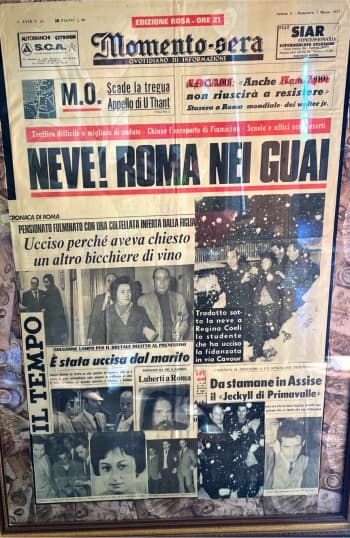
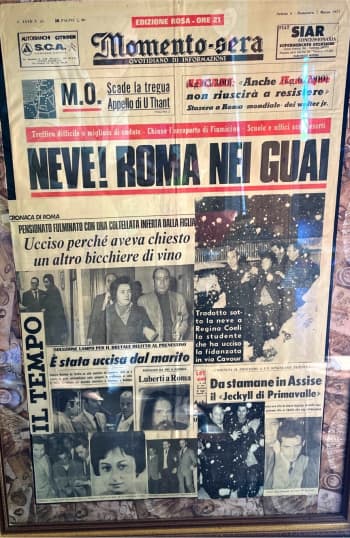
Behind the Names That Made History
Then there are the names that have become part of Italy's public history: Montesi, Bulgari and Pasolini.
For Raffaele's family, these were not simply newspaper headlines to collect, but fragments of a professional life he had rarely spoken about.
Historical newspapers, archives and records concerning Rome's Squadra Mobile help reconstruct the investigations. They do not always identify individual officers. De Blasio's involvement in these cases is remembered by his family, drawing also on information they later received from colleagues who had worked alongside him.
Montesi, 1953
The body of Wilma Montesi was found on the beach at Torvaianica in April 1953.
Contemporary sources confirm that Rome's Squadra Mobile was involved from the earliest stages of the investigation. At the time, Maglioni was a senior commissioner of the Rome Squadra Mobile, Carella was operating in Ostia Lido, and Barbarino participated in the initial investigative activities.
According to the family chronology, De Blasio had only recently begun his investigative career.
Although the digitised records consulted do not name him in connection with the Montesi case, his family recalls his involvement, based partly on information subsequently received from colleagues in the Squadra Mobile.
Bulgari, 1975
Gianni Bulgari was kidnapped in Rome on 31 March 1975.
An article published in l'Unità in December 1976 reported that Rome's Squadra Mobile conducted the investigation and identified Demetrio Ambrosi Grapelli, who was subsequently committed for trial during proceedings overseen by investigating judge Ferdinando Imposimato.
An autobiographical account by Ennio Di Francesco places Fernando Masone at the head of Rome's Squadra Mobile in 1975, with Carlo Iovinella leading its Kidnapping Section.
The consulted sources do not directly identify Raffaele De Blasio in the Bulgari investigation. His participation is recalled by his family, based also on information later received from colleagues in the Squadra Mobile, within the context of the team's collective investigative work.
Pasolini, 2 November 1975
The Pasolini case offers a different kind of evidence: a photograph preserved by the De Blasio family.
Pier Paolo Pasolini's body was discovered at the Idroscalo in Ostia on the morning of 2 November 1975. Historical accounts place Fernando Masone, head of Rome's Squadra Mobile, at the scene. Digitised archives also preserve police reports, judicial records and documents from the days immediately following the discovery.
Among the photographs kept by the De Blasio family is an image that his children associate with the scene where Pasolini's body was found.
They identify Raffaele as the man in the centre wearing a tie and speaking with colleagues. According to their recollections, forensic police officers can also be seen in the background.
His children explain that the photograph was given to the family by colleagues from Rome's Squadra Mobile as a record of their father's work.
Additional searches were conducted through external photographic archives. Marco Ravagli reported that he had searched for material relating both to Raffaele De Blasio and to the Idroscalo, without finding further relevant photographs.
The family photograph is therefore presented with transparent attribution of its provenance and identification, rather than as independently verified archival evidence.
THE LIFE HIS FAMILY NEVER SAW
There is a particular distance between an investigator's professional life and the lives of those waiting for him at home.
For Raffaele's children, much of their father's world remained inaccessible. They knew his profession, but not the full extent of what it demanded of him.
Only after his death did many details begin to acquire meaning. A photograph, a name mentioned by a former colleague, an episode recalled years later — each fragment revealed something more about the man they had grown up with.
These discoveries did not change the father they had known. They revealed how much of his life had necessarily remained beyond the family home.
His dedication came at a personal cost. His children experienced the consequences of his profession without always understanding the investigations behind them.
Yet their memories also reveal another side of Raffaele.
“On the surface, he seemed emotionally distant, but whenever I needed him, he was always there.”
His son says he came to understand this differently when he became a father himself: affection was not always expressed openly, but his father's presence could be counted on when it mattered.
Behind the investigator's silence was a father whose commitment to his family was often expressed through actions rather than words.
THE PHOTOGRAPH THAT REMAINS
Raffaele De Blasio in uniform. Photograph preserved by his family and chosen by his children as the image that best represents their father and his journey from humble beginnings to a career in the Italian police.
Raffaele De Blasio in uniform. Photograph preserved by his family and chosen by his children as the image that best represents their father and his journey from humble beginnings to a career in the Italian police.
When Raffaele's children are asked which photograph best represents their father, they do not choose an image from a crime scene or a newspaper clipping.
They choose a photograph of him in uniform.
In that image, he is still the young police officer, before the years would replace the uniform with plain-clothes investigative work and turn the promise of a career into decades of experience.
For his children, the photograph represents an achievement: a young man from a farming family who found in the police not simply a job, but a tangible expression of his sense of duty.
The major investigations, the long nights, the waiting and the changing face of Rome's criminal world would come later. So would the silences that kept his professional life separate from his family.
But in this photograph, everything still seems to lie ahead.
Perhaps that is why his family chose it. Before the famous cases and newspaper headlines, it captures the man who would remain faithful to himself and to the institution he served.
The major cases were part of his story, but what his children most want to preserve is his integrity: pride in his work, intellectual honesty and the same values carried into family life.
Behind an apparently ordinary man was a life shaped by observation, discretion and work that often remained beyond public view — even from those closest to him.
What Remains of an Investigator
To tell Raffaele De Blasio's story is to follow a man through decades of Rome's history without reducing his life to the investigations in which he took part.
The discipline of the young police officer, the investigator's observant eye, the father's discretion, the public servant's sense of responsibility and the cheerful man remembered outside work were all part of the same person.
His children came to understand much of that life only years later. Colleagues' recollections, photographs and fragments of memory gradually revealed what had remained outside the family's everyday experience.
For decades, Raffaele worked in a profession where success did not necessarily mean becoming the public face of an investigation. Newspaper reports focused on crimes, victims, suspects and arrests. Behind those accounts stood the daily work of those who observed, verified information and followed investigative leads.
This story seeks to bring one of those lives into view, without turning its subject into a hero retrospectively or attributing to him achievements that cannot be independently documented.
His family remembers a man of exceptional seriousness and integrity, deeply loyal to the institutions he served, but also capable of warmth, humour and simple human connections.
From Benevento to Rome, from his early years in uniform to decades of investigative work, one quality remained constant: the way he observed the world.
He noticed everything. And for those who knew him, he never truly stopped.
Sources and Research Notes
This multimedia story draws on historical newspapers, archival research, documentary sources, interviews and materials preserved by the De Blasio family.
A Note on Historical Verification
The historical research reconstructs the investigative context of the Montesi, Bulgari and Pasolini cases and, where documented, the involvement of Rome's Squadra Mobile.
The digitised records consulted do not directly identify Raffaele De Blasio in connection with these three cases. His participation is attributed by his family, drawing on their recollections and information subsequently received from colleagues who worked alongside him.
The absence of his name from the consulted newspaper reports does not establish that he was absent from the investigations. Equally, the family's recollections are not presented as independent documentary confirmation of his specific operational involvement.
The story therefore distinguishes between historically documented events, collective investigative work and personal testimony.
Photographs preserved by the family are attributed accordingly, including the image associated with the Pasolini investigation, whose identification and provenance are based on the family's account.
 Built with Shorthand